
Only 5% of Americans meet their daily fiber intake recommendations — and for adults over 65, that gap is even wider. If you’ve been dealing with sluggish digestion, unpredictable bowel habits, or just wondering why your doctor keeps mentioning fiber at every visit, you’re in the right place. This complete guide to high fiber foods for seniors covers everything: why fiber matters more as you age, which foods pack the biggest punch, and how to build a practical meal plan that actually works in real life.

Key Takeaways
- Seniors need 21–30g of fiber daily, but most get less than half that amount
- Both soluble and insoluble fiber play different but equally important roles in digestive health
- Legumes, whole grains, fruits, and vegetables are the most powerful high fiber foods for older adults
- Increasing fiber gradually — alongside adequate water intake — prevents bloating and discomfort
- A geriatric nutritionist can create a personalized fiber plan tailored to medications and health conditions
Why Fiber Becomes Even More Important After 65
Here’s something most people don’t realize: the digestive system slows down significantly with age. Muscle contractions in the gut become weaker, medications like iron supplements and pain relievers slow things further, and physical activity often decreases — all of which contribute to constipation and digestive discomfort.
My grandmother used to joke that her “plumbing” started acting up the moment she turned 70. She wasn’t wrong. Research consistently shows that constipation affects up to 40% of adults over 65, making it one of the most common health complaints in older populations.
But fiber does far more than keep things moving. Here’s what adequate fiber intake does for seniors:
- 🫀 Heart health — Soluble fiber lowers LDL (“bad”) cholesterol
- 🩸 Blood sugar control — Slows glucose absorption, reducing diabetes risk
- ⚖️ Weight management — Increases satiety, reducing overeating
- 🦠 Gut microbiome support — Feeds beneficial bacteria in the colon
- 🧠 Cognitive protection — Emerging research links gut health to brain health
- 💪 Reduced inflammation — High-fiber diets are associated with lower inflammatory markers
“Dietary fiber is one of the most underutilized tools in healthy aging. It’s cheap, accessible, and profoundly effective.” — Common consensus among registered dietitians
How Much Fiber Do Seniors Actually Need?
| Age Group | Recommended Daily Fiber (Women) | Recommended Daily Fiber (Men) |
|---|---|---|
| 19–50 years | 25g | 38g |
| 51+ years | 21g | 30g |
| Average actual intake (65+) | ~12–15g | ~12–15g |
The gap between what seniors need and what they actually eat is striking. The good news? Closing that gap is very doable with the right food choices.
Understanding the Two Types of Fiber
Before diving into the food lists, it helps to understand that not all fiber works the same way.
Soluble fiber dissolves in water to form a gel-like substance. It’s the type that lowers cholesterol, stabilizes blood sugar, and feeds your gut bacteria. Think oats, beans, apples, and flaxseeds.
Insoluble fiber doesn’t dissolve — it adds bulk to stool and speeds up transit through the intestines. This is your go-to for constipation relief. Think whole wheat, bran, nuts, and most vegetables.
Most high fiber foods contain a mix of both types, which is why eating a variety of fiber-rich foods is more effective than focusing on just one source.
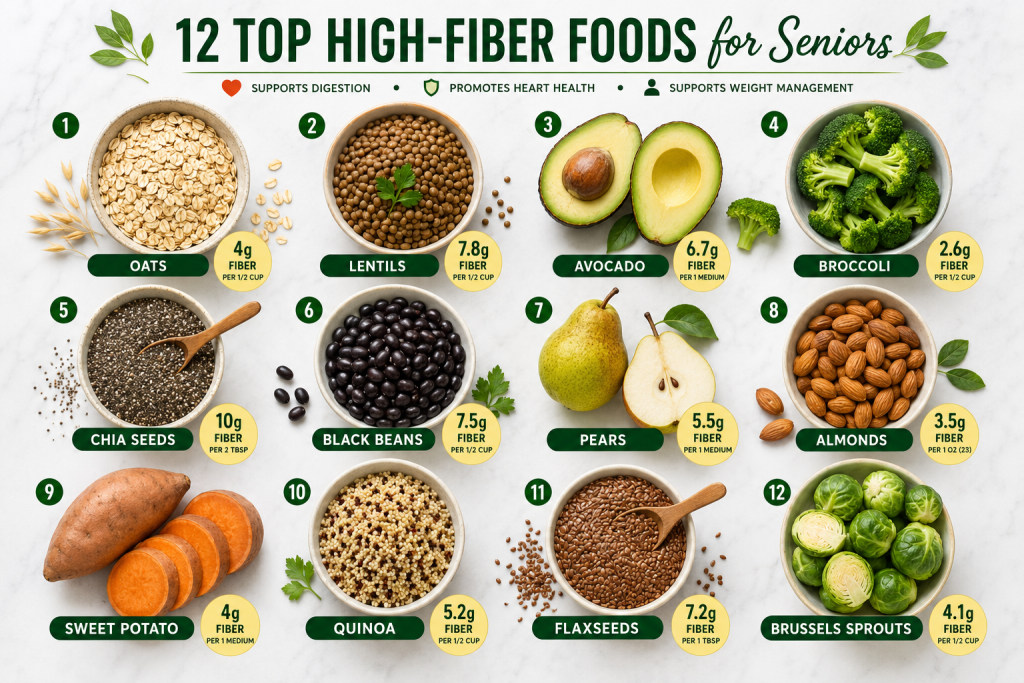
The Top High Fiber Foods for Seniors
Here’s where it gets practical. I’ve organized the best high fiber foods into easy-to-navigate categories so you can find options that suit your taste, budget, and cooking ability.
🫘 Legumes — The Fiber Powerhouses
Legumes are arguably the single best category of high fiber foods for older adults. They’re affordable, versatile, and loaded with both fiber and protein.
| Food | Serving Size | Fiber Content |
|---|---|---|
| Navy beans (cooked) | ½ cup | 9.6g |
| Black beans (cooked) | ½ cup | 7.5g |
| Lentils (cooked) | ½ cup | 7.8g |
| Chickpeas (cooked) | ½ cup | 6.2g |
| Split peas (cooked) | ½ cup | 8.1g |
| Kidney beans (cooked) | ½ cup | 6.9g |
| Edamame | ½ cup | 4.0g |
Pro tip: Canned beans are just as nutritious as dried — just rinse them to reduce sodium. They’re one of the easiest ways to add fiber to any meal without extra cooking.
🌾 Whole Grains — Everyday Fiber Staples
Switching from refined grains to whole grains is one of the simplest dietary upgrades a senior can make.
- Oats — 4g per ½ cup (dry); rich in beta-glucan, a soluble fiber that actively lowers cholesterol
- Barley — 3g per ½ cup cooked; one of the highest-fiber grains available
- Quinoa — 2.6g per cup cooked; also a complete protein
- Brown rice — 1.8g per cup cooked
- Whole wheat bread — 2g per slice
- Bulgur wheat — 4g per ½ cup cooked
- Whole grain pasta — 3.2g per cup cooked
- Popcorn — 3.5g per 3 cups; yes, popcorn counts! 🍿
🍎 Fruits — Sweet and Fiber-Rich
Fresh fruit is a natural, enjoyable way to boost fiber intake. Many seniors find fruit easier to eat than vegetables, especially those with dental issues or reduced appetite.
Top fiber fruits:
- Pear — 5.5g per medium fruit (eat the skin!)
- Avocado — 10g per whole avocado; also rich in healthy fats
- Raspberries — 8g per cup; one of the highest-fiber fruits
- Blackberries — 7.6g per cup
- Apple — 4.4g per medium (with skin)
- Banana — 3.1g per medium; also provides potassium
- Orange — 3.1g per medium
- Mango — 3g per cup
- Guava — 9g per cup; incredibly fiber-dense
- Kiwi — 2.7g per fruit; also shown to specifically help with constipation
🥦 Vegetables — The Unsung Fiber Heroes
Vegetables provide insoluble fiber that’s particularly effective for relieving constipation — a major concern for many seniors.
Best high-fiber vegetables:
- Artichoke — 10.3g per medium; the fiber champion of vegetables
- Green peas — 8.8g per cup cooked
- Broccoli — 5.1g per cup cooked
- Brussels sprouts — 4.1g per cup cooked
- Sweet potato — 4g per medium (with skin)
- Carrots — 3.6g per cup raw
- Spinach — 4.3g per cup cooked
- Kale — 2.6g per cup raw
- Beets — 3.8g per cup cooked
- Parsnips — 5.6g per cup cooked
- Turnips — 3.1g per cup cooked
- Corn — 3.6g per cup cooked
🌰 Nuts, Seeds, and Other Fiber Boosters
These small-but-mighty foods can significantly increase daily fiber intake without adding much volume to meals.
- Chia seeds — 10g per 2 tablespoons; also rich in omega-3s
- Flaxseeds (ground) — 3.8g per 2 tablespoons; must be ground for absorption
- Almonds — 3.5g per ounce (about 23 almonds)
- Sunflower seeds — 3.9g per ounce
- Pistachios — 2.9g per ounce
- Walnuts — 2g per ounce
- Psyllium husk — 5g per tablespoon; often used as a fiber supplement
Daily Fiber Goal Tracker Constipation Relief for Seniors
Constipation is the number one reason seniors are told to eat more fiber — and for good reason. But not all fiber helps equally when it comes to getting things moving.
For constipation relief, prioritize:
- Insoluble fiber first — wheat bran, whole grains, leafy vegetables
- Kiwi fruit — multiple studies show kiwi specifically improves bowel frequency
- Prunes and prune juice — contain sorbitol, a natural laxative compound, plus 2g fiber per prune
- Flaxseeds — add ground flaxseed to yogurt, oatmeal, or smoothies
- Psyllium husk — a concentrated fiber supplement that absorbs water and softens stool
⚠️ Important warning: Increasing fiber too quickly can cause bloating, gas, and cramping. Add fiber gradually — about 5g per week — and drink at least 8 glasses of water daily. Fiber without adequate hydration can actually worsen constipation.
If you’re exploring nutrition drinks for elderly as part of a broader nutrition strategy, look for options that include fiber alongside protein and vitamins.
How to Build a High-Fiber Meal Plan for Seniors
The best meal plan is one you’ll actually follow. Here’s a practical 3-day sample to show how easy it is to hit your fiber goals.
Sample 3-Day High-Fiber Meal Plan
Day 1
- Breakfast: Oatmeal with raspberries and ground flaxseed (~14g fiber)
- Lunch: Lentil soup with whole grain bread (~12g fiber)
- Dinner: Baked salmon with roasted broccoli and brown rice (~7g fiber)
- Snack: Apple with almond butter (~6g fiber)
- Daily total: ~39g ✅
Day 2
- Breakfast: Whole grain toast with avocado and a pear (~12g fiber)
- Lunch: Black bean and vegetable wrap (~10g fiber)
- Dinner: Chicken stir-fry with edamame and quinoa (~9g fiber)
- Snack: Handful of almonds and an orange (~7g fiber)
- Daily total: ~38g ✅
Day 3
- Breakfast: Greek yogurt with chia seeds and blackberries (~13g fiber)
- Lunch: Split pea soup with a side salad (~12g fiber)
- Dinner: Beef and vegetable stew with barley (~9g fiber)
- Snack: Popcorn and a banana (~6g fiber)
- Daily total: ~40g ✅
Practical Tips for Getting More Fiber Daily
- Add beans to everything — soups, salads, pasta, rice dishes
- Swap refined grains for whole grains — brown rice instead of white, whole wheat pasta instead of regular
- Keep fruit visible — a bowl of apples and pears on the counter makes snacking easy
- Sprinkle seeds — add chia or ground flaxseed to yogurt, smoothies, or oatmeal
- Leave the skin on — apple, pear, and potato skins contain significant fiber
- Blend a fiber smoothie — frozen berries, banana, spinach, and chia seeds make a powerful fiber drink
If you’re also monitoring protein intake alongside fiber, our guide on protein supplements for elderly patients covers how to balance both macronutrients effectively.
Special Considerations for Seniors
Fiber and Medications
Some seniors take medications that interact with fiber. For example:
- Digoxin — Fiber can reduce absorption; take medications 1–2 hours before a high-fiber meal
- Metformin — High fiber can enhance blood sugar control but may require medication adjustments
- Warfarin — Sudden large increases in leafy greens can affect INR levels
Always talk to your doctor or a geriatric nutritionist before making dramatic dietary changes, especially if you’re on multiple medications.
Dental Issues and Chewing Difficulties
Many seniors avoid high-fiber foods because they’re hard to chew. Here are soft, high-fiber alternatives:
- Smoothies with berries, banana, and chia seeds
- Pureed soups made with lentils, split peas, or beans
- Soft-cooked oatmeal with mashed banana
- Avocado — naturally soft and fiber-rich
- Canned beans — soft enough to mash easily
- Cooked vegetables — steamed carrots, spinach, and sweet potato
Fiber and Hydration
This point cannot be overstated: fiber and water work as a team. Seniors are already at higher risk of dehydration because the sensation of thirst diminishes with age. When increasing fiber intake, consciously increase water intake at the same time. Aim for at least 8 cups (2 litres) of water daily.
Should Seniors Take Fiber Supplements?
Whole foods are always the preferred source of fiber because they come packaged with vitamins, minerals, antioxidants, and phytonutrients that supplements simply can’t replicate. However, fiber supplements can be a useful bridge when:
- Appetite is significantly reduced
- Chewing difficulties make high-fiber foods hard to eat
- A medical condition limits certain food groups
- Fiber needs are temporarily elevated (e.g., post-surgery recovery)
Common fiber supplements include:
- Psyllium husk (Metamucil) — most researched, effective for both constipation and cholesterol
- Methylcellulose (Citrucel) — less gas-producing than psyllium
- Inulin/FOS — prebiotic fiber that feeds gut bacteria
- Wheat dextrin (Benefiber) — dissolves easily in drinks
If you’re considering meal replacement shakes for elderly as a nutrition strategy, check whether they include fiber as part of their formulation — many don’t, which means you’d need to supplement separately.
High Fiber Foods and Long-Term Health Outcomes
The evidence connecting high fiber intake to better health outcomes in older adults is genuinely impressive. Let me share some of the most compelling findings:
Cardiovascular disease: A landmark meta-analysis found that every 7g increase in daily fiber intake was associated with a 9% reduction in cardiovascular disease risk. For seniors who are already managing heart health, this is significant.
Type 2 diabetes: Soluble fiber slows glucose absorption, reducing post-meal blood sugar spikes. Studies consistently show that high-fiber diets reduce the risk of developing type 2 diabetes and help manage existing diabetes.
Colorectal cancer: The World Health Organization classifies high dietary fiber intake as protective against colorectal cancer — one of the most common cancers in older adults.
Gut microbiome: Fiber feeds beneficial bacteria like Bifidobacterium and Lactobacillus, which produce short-chain fatty acids that reduce inflammation throughout the body, including in the brain.
Longevity: A large Australian study found that people with the highest fiber intake had a 15–17% lower risk of dying from any cause over a 10-year follow-up period.
“Eating fiber-rich foods isn’t just about digestion — it’s one of the most powerful dietary strategies for healthy aging overall.”
Staying active also complements a high-fiber diet beautifully. Programs like cycling for Gold Coast seniors show how combining movement with good nutrition creates compounding health benefits for older adults.
Common Mistakes Seniors Make with Fiber
Even well-intentioned seniors can go wrong with fiber. Here are the most common pitfalls:
❌ Adding too much fiber too fast — causes gas, bloating, and cramping. Increase gradually.
❌ Not drinking enough water — fiber without hydration can worsen constipation.
❌ Relying only on supplements — missing out on the full nutritional package that whole foods provide.
❌ Avoiding all gas-producing foods — beans and cruciferous vegetables cause temporary gas as your gut adjusts, but this typically resolves within a few weeks.
❌ Assuming “whole grain” on a label means high fiber — always check the nutrition panel. Some “whole grain” products contain as little as 1g of fiber per serving.
❌ Forgetting that fruit juice has no fiber — eat the whole fruit, not just the juice.
When to See a Professional
If you’ve increased fiber intake and are still experiencing significant constipation, bloating, or digestive discomfort, it’s worth speaking to a healthcare professional. Persistent digestive issues in seniors can sometimes indicate underlying conditions like irritable bowel syndrome, diverticulitis, or medication side effects that need proper assessment.
A geriatric nutritionist can create a personalized fiber plan that accounts for your specific health conditions, medications, food preferences, and cooking abilities. This is especially valuable for seniors managing multiple chronic conditions simultaneously.
Retirement living also plays a role in nutrition. If you’re exploring options like retirement village living, it’s worth asking about the dietary options available — specifically whether meals include adequate fiber-rich foods.
Conclusion
Getting enough fiber after 65 doesn’t have to be complicated or expensive. The most powerful high fiber foods — beans, lentils, oats, fruits, and vegetables — are everyday, affordable staples that can be incorporated into almost any meal.
Here are your actionable next steps:
- Track your current intake — use the interactive tracker above to see where you stand
- Start with one swap — replace white bread with whole grain, or add a handful of berries to breakfast
- Add beans to two meals per week — they’re the single most fiber-efficient food available
- Drink more water — aim for 8 cups daily, especially as you increase fiber
- Increase gradually — add about 5g of fiber per week to avoid digestive discomfort
- Consult a professional — if you have health conditions or take multiple medications, a geriatric nutritionist can tailor a plan specifically for you
Fiber is one of the most underrated tools in healthy aging. It’s not glamorous, it’s not expensive, and it doesn’t require a prescription — but the evidence for its benefits is overwhelming. Start small, stay consistent, and your digestive system (and the rest of your body) will thank you.