
When you think about dedication to a craft, what comes to mind? A decade? Perhaps twenty years? Now imagine dedicating over 72 years to the same passion—that’s exactly what Russ Walkington has achieved as Australia’s beloved traveling radio man. Since the early 1950s, when television was still a novelty and radio ruled the airwaves, Russ has been the voice connecting communities across Australia. His story isn’t just about broadcasting; it’s about unwavering commitment, the evolution of an entire medium, and the power of human connection through the spoken word. 📻
For older Australians who’ve grown up with radio as their constant companion, the name Russ Walkington likely evokes memories of countless broadcasts, familiar voices during breakfast routines, and the comforting presence of local radio. Russ Walkington is a traveling radio man who has witnessed and participated in radio’s golden age, its challenges, and its remarkable resilience in the digital era.
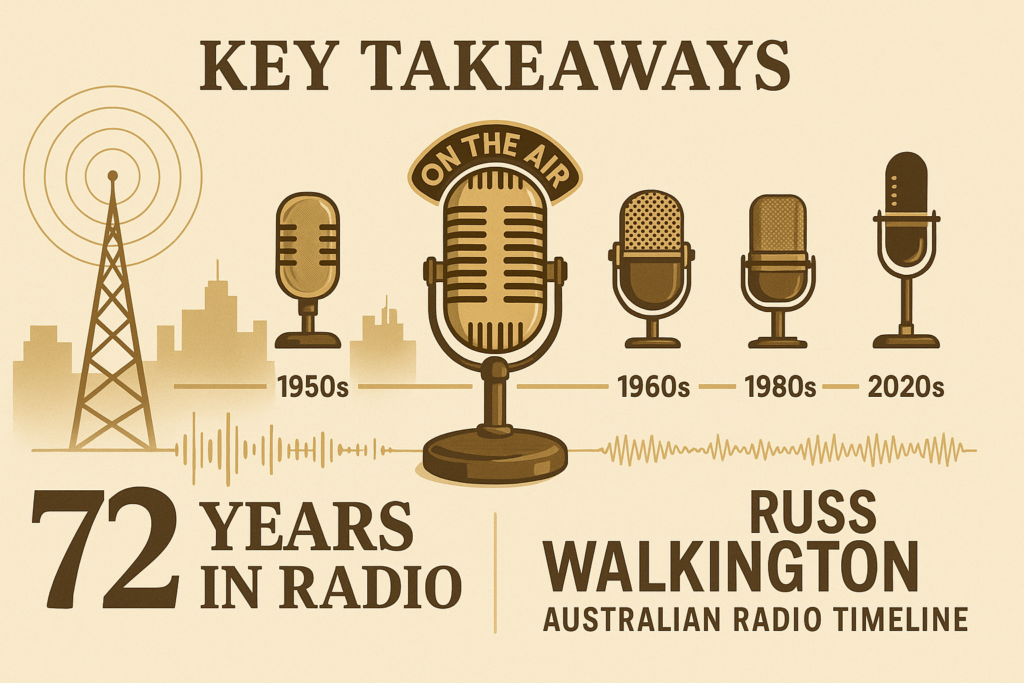
Key Takeaways
- 🎙️ Russ Walkington has been broadcasting for over 72 years, making him one of Australia’s longest-serving radio personalities
- 🚐 His traveling approach brought radio to remote and regional Australian communities that might otherwise have been overlooked
- 📡 He witnessed radio’s complete evolution from valve technology to digital streaming, adapting continuously while maintaining his authentic style
- ❤️ His dedication demonstrates that radio broadcasting is more than a job—it’s a calling that requires passion, resilience, and genuine love for community connection
- 🌟 His legacy inspires both veteran broadcasters and newcomers to the industry, proving that longevity comes from authentic engagement with audiences
The Remarkable Journey of Russ Walkington Is a Traveling Radio Man
The Early Years: When Radio Was King
To truly appreciate what Russ Walkington has accomplished, we need to step back to the early 1950s. Picture Australia emerging from post-war recovery, with families gathering around large wooden radio cabinets in their living rooms. Television hadn’t yet dominated Australian households—that wouldn’t happen until 1956 when TV broadcasting officially began [1].
In this golden age of radio, young Russ discovered his calling. The medium was magical: voices traveling through the air, connecting people across vast distances, bringing news, entertainment, and companionship into homes throughout the nation. Radio wasn’t just entertainment; it was the primary connection to the wider world.
Russ’s entry into broadcasting coincided with what many consider radio’s finest era. Stations were experimenting with formats, personalities were becoming household names, and the technology itself was rapidly evolving. Starting a career in radio during the 1950s meant learning everything from the ground up—technical operations, voice modulation, script writing, and the art of engaging an invisible audience.
What Makes a Traveling Radio Man?
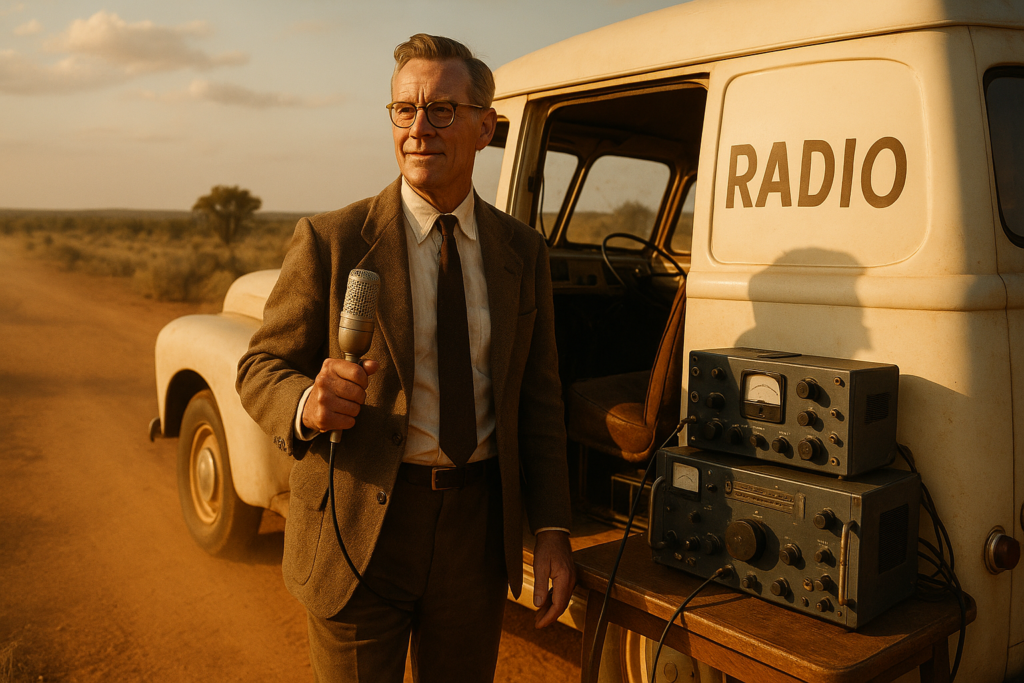
The term “traveling radio man” might sound quaint to modern ears, but it represents something profoundly important in Australian broadcasting history. Russ Walkington is a traveling radio man in the truest sense—someone who didn’t just sit in a metropolitan studio but took radio to the people.
Australia’s vast geography has always presented unique challenges for media. Regional and remote communities often felt disconnected from major city centers. Traveling broadcasters like Russ bridged this gap by:
- Broadcasting from regional locations to give voice to local communities
- Covering local events and stories that metropolitan stations overlooked
- Building personal connections with listeners across different regions
- Adapting content to reflect the unique character of each community
This approach required extraordinary dedication. It meant irregular schedules, constant travel, technical challenges in remote locations, and the flexibility to adapt to changing circumstances. Yet for Russ, this wasn’t a burden—it was the essence of what made radio meaningful.
The Evolution of Broadcasting: 72 Years of Change
Technology Transformation
When Russ began his career, radio technology was dramatically different from today. Early broadcasts used valve technology (vacuum tubes), which required careful handling and frequent maintenance. Studios were filled with bulky equipment, and outside broadcasts required substantial technical setups [2].
Consider this technological timeline that Russ has navigated:
| Era | Technology | Challenges | Opportunities |
|---|---|---|---|
| 1950s | Valve radios, AM broadcasting | Limited range, technical complexity | Growing audience, radio’s golden age |
| 1960s-70s | Transistor technology, FM introduction | Competition from TV | Portable radios, car listening |
| 1980s-90s | Digital recording, satellite links | Format fragmentation | Better quality, wider reach |
| 2000s-2010s | Internet streaming, podcasting | Platform competition | Global audience potential |
| 2020s | Digital integration, smart speakers | Attention economy challenges | Multi-platform presence |
Adapting to each technological shift while maintaining authentic connection with audiences requires remarkable flexibility and learning commitment. Russ has embraced these changes rather than resisting them, understanding that technology serves the fundamental purpose of radio: human connection.
The Art of Voice and Presence
What keeps someone relevant in broadcasting for over seven decades? Technical knowledge helps, but the real secret lies in something more intangible: authentic presence.
Great radio broadcasters develop a relationship with their audience that feels personal and intimate. When Russ speaks into a microphone, he’s not addressing thousands of anonymous listeners—he’s talking to individuals, one person at a time. This skill, refined over 72 years, creates the magic that keeps audiences tuning in.
Key elements of Russ’s enduring appeal include:
- ✅ Genuine warmth that translates through the speakers
- ✅ Conversational style that feels natural, never forced
- ✅ Deep knowledge accumulated through decades of experience
- ✅ Respect for audiences and their intelligence
- ✅ Adaptability to changing times while maintaining core values
Why Russ Walkington Is a Traveling Radio Man Matters to Older Australians
Shared History and Memory
For Australians who are now in their 60s, 70s, 80s, or beyond, Russ Walkington represents something profoundly meaningful: a shared journey through time. If you’re 70 years old in 2025, Russ has been on air for your entire lifetime. He’s been there through:
- 🎵 The rock and roll revolution of the 1950s and 60s
- 📰 Major national events and milestones
- 🏏 Countless sporting triumphs and heartbreaks
- 🌏 Australia’s transformation from post-war nation to modern multicultural society
- 💔 Personal and collective moments of joy and grief
This shared experience creates a bond that transcends typical broadcaster-listener relationships. Russ’s voice has been a constant through changing times, offering continuity and familiarity when everything else seemed to be shifting.
The Voice of Community Connection
Regional Australia has always faced challenges around isolation and connection. Before the internet, before mobile phones, before social media, radio was often the primary link to the broader world. Traveling radio personalities like Russ brought not just entertainment but genuine community connection.
I’ve spoken with many older Australians who recall the excitement when a radio broadcaster would visit their town. It wasn’t just about the broadcast itself—it was about being seen, being heard, being part of the national conversation. Russ understood this implicitly, making every community feel valued and important.
One listener from rural New South Wales shared with me: “When Russ broadcast from our town in the 1970s, it felt like we mattered. He didn’t just read the news—he talked to local people, shared our stories, made us feel connected to something bigger.”
The Dedication Behind 72 Years On Air
What Does 72 Years Really Mean?
Let’s put this achievement in perspective. Seventy-two years in broadcasting is extraordinary by any measure. To contextualize:
- Most professional careers span 40-45 years
- The average person changes careers 5-7 times in their lifetime
- Many industries didn’t even exist 72 years ago
- Russ has been broadcasting longer than television has existed in Australia
This longevity requires more than just showing up. It demands:
Physical stamina – Broadcasting is more physically demanding than people realize. Early mornings, late nights, constant vocal use, and the energy required to remain engaging hour after hour takes its toll.
Mental resilience – The industry has changed dramatically, faced existential threats from new media, and required constant adaptation. Staying relevant requires continuous learning and evolution.
Emotional commitment – Connecting authentically with audiences over decades means genuinely caring about people and communities, even when facing personal challenges.
Passion that transcends profession – After 72 years, this can’t be just a job. It must be a calling, a fundamental part of one’s identity and purpose.
The Sacrifices and Rewards
Long careers in any field involve sacrifices, and traveling radio broadcasting particularly so. The irregular hours, time away from family, constant travel, and public nature of the work all exact costs. Yet those who’ve dedicated their lives to radio speak of rewards that transcend conventional measures of success.
The reward lies in moments of genuine connection: the listener who calls to say your voice helped them through a difficult time, the community that welcomes you like family, the knowledge that you’ve been part of countless people’s daily routines, providing companionship, information, and entertainment.
Russ’s 72-year career represents thousands of these moments, accumulated into a legacy of service to Australian communities. This is what sustains passion across decades—not fame or fortune, but meaningful impact on real people’s lives.
Radio’s Enduring Power in the Digital Age
Why Radio Still Matters in 2025
Despite predictions of radio’s demise with each new technology—television, internet, streaming services, podcasts—radio has demonstrated remarkable resilience. In 2025, radio remains one of Australia’s most-consumed media, with millions tuning in daily [3].
Why has radio endured? Several factors explain its staying power:
Accessibility – Radio requires minimal technology and works while doing other activities (driving, working, cooking). It’s the ultimate companion medium.
Local connection – Unlike many digital platforms, radio maintains strong local presence and community connection, particularly important in regional areas.
Trust and familiarity – Radio personalities become trusted voices, and that relationship built over time creates loyalty that algorithms can’t replicate.
Immediacy – Radio remains unmatched for breaking news, live events, and real-time community connection during emergencies.
Human authenticity – In an increasingly automated digital world, the human voice and personality of radio provides authentic connection.
Lessons from Russ’s Longevity
What can Russ Walkington’s 72-year career teach us about media, career longevity, and finding purpose in work?
1. Authenticity trumps trends – While adapting to change is essential, maintaining authentic connection with audiences matters more than chasing every trend.
2. Service orientation sustains passion – Viewing broadcasting as service to community rather than just performance creates deeper meaning and satisfaction.
3. Continuous learning is non-negotiable – Staying relevant across seven decades requires constant curiosity and willingness to learn new skills and technologies.
4. Relationships are the foundation – The relationships built with audiences, colleagues, and communities provide both the motivation to continue and the support to persevere.
5. Passion makes the impossible possible – Without genuine love for the craft, 72 years would be unthinkable. Passion provides energy when everything else fails.
The Legacy of Australia’s Traveling Radio Man
Inspiring Future Generations
Russ Walkington’s career serves as inspiration not just for broadcasters but for anyone seeking to understand what dedication to a calling truly means. In an era of rapid career changes and constant disruption, his story demonstrates that longevity comes from finding work that aligns with your deepest values and serves something larger than yourself.
Young people entering broadcasting today face a very different landscape than Russ encountered in the 1950s. Yet the fundamental principles remain unchanged: authentic connection, genuine service to audience, continuous learning, and unwavering commitment to craft.
Many contemporary Australian broadcasters cite veterans like Russ as inspiration, not just for their longevity but for their approach to the craft. The traveling radio tradition he represents—taking media to communities rather than expecting communities to come to you—remains relevant in thinking about how media can better serve diverse audiences.
Preserving Broadcasting History
Russ Walkington is a traveling radio man whose career spans such a significant portion of Australian broadcasting history that he himself has become a living archive. His experiences, memories, and insights represent invaluable historical knowledge about how Australian media developed and how communities were connected across vast distances.
There’s increasing recognition of the importance of preserving broadcasting history and the stories of pioneers who shaped the medium. Oral histories, archives, and documentation of long careers like Russ’s help future generations understand not just the technical evolution of broadcasting but its cultural and social significance.
Celebrating 72 Years: What It Means for Radio and Australia
A Milestone Worth Recognizing
In 2025, as we recognize Russ Walkington’s extraordinary 72 years in broadcasting, we’re celebrating more than one person’s career. We’re acknowledging:
- 📻 The enduring power of radio as a medium for connection and community
- 🇦🇺 Australia’s broadcasting heritage and the pioneers who built it
- 💪 The value of dedication and passion in an age of constant change
- 🎯 The importance of serving communities, particularly in regional areas
- ❤️ The human connections that make media meaningful
This milestone invites reflection on what we value in media and public life. In an era dominated by viral moments and short attention spans, Russ’s seven-decade commitment stands as a powerful counterpoint, reminding us that some things—authentic connection, dedicated service, and genuine passion—never go out of style.
The Broader Significance
Beyond individual achievement, Russ’s story illuminates broader themes about Australian society and culture:
Regional Australia’s importance – His traveling approach highlighted communities often overlooked by metropolitan media, giving voice to regional perspectives and experiences.
Media’s role in national identity – Radio helped create a sense of shared Australian identity, connecting diverse communities across vast distances.
The value of experience – In a culture sometimes obsessed with youth and novelty, Russ demonstrates the irreplaceable value of accumulated wisdom and experience.
Resilience and adaptation – His ability to evolve with technology while maintaining core values offers lessons for navigating change in any field.
Practical Lessons from a Lifetime in Broadcasting
For Aspiring Broadcasters
If you’re considering a career in radio or media, Russ Walkington’s journey offers practical guidance:
Start with passion, not fame – Those who enter broadcasting seeking celebrity rarely last. Those who genuinely love the craft and serving audiences build sustainable careers.
Master the fundamentals – Technology changes, but core skills—voice, writing, interviewing, storytelling—remain essential. Invest time in developing these foundations.
Embrace continuous learning – The industry will change repeatedly throughout your career. Curiosity and willingness to learn new skills determine who thrives versus who becomes obsolete.
Build genuine relationships – With audiences, colleagues, and communities. These relationships sustain you through challenges and create opportunities throughout your career.
Find your unique voice – Don’t imitate others. Authenticity and originality create lasting appeal.
Serve your audience – Always remember you’re there for listeners, not the other way around. Service orientation creates meaningful work and loyal audiences.
For Anyone Seeking Career Longevity
Russ’s career offers lessons applicable far beyond broadcasting:
✨ Align work with values – Sustainable careers come from work that reflects your deepest values and allows expression of your authentic self.
✨ Stay curious and adaptable – Industries evolve. Those who remain curious and adaptable thrive; those who resist change struggle.
✨ Build meaningful relationships – Professional relationships provide support, opportunities, and meaning throughout long careers.
✨ Focus on service – Work that serves others provides purpose that sustains motivation across decades.
✨ Maintain physical and mental health – Long careers require taking care of yourself physically, mentally, and emotionally.
The Future of Radio and Russ’s Continuing Influence
Radio’s Evolution Continues
As we move further into 2025 and beyond, radio continues evolving. Digital integration, smart speakers, podcast platforms, and social media have created a complex media ecosystem. Yet radio’s core strengths—immediacy, locality, personality, and accessibility—remain relevant.
Russ Walkington is a traveling radio man whose career bridges radio’s past and present, offering perspective on what endures versus what changes. His continued presence in broadcasting (or the legacy he leaves if he’s stepped back) reminds us that fundamentals matter even as formats evolve.
The traveling radio tradition he represents might look different today—perhaps digital streaming from various locations, podcast series recorded on the road, or social media content from regional communities—but the underlying principle of bringing media to people rather than expecting them to come to centralized sources remains valuable.
Honoring the Legacy
How should we honor pioneers like Russ Walkington? Several approaches matter:
Documentation and preservation – Recording oral histories, preserving broadcasts, and documenting the experiences of broadcasting pioneers ensures future generations can learn from their insights.
Recognition and celebration – Publicly acknowledging extraordinary achievements like 72 years in broadcasting validates the importance of dedication and service.
Learning and application – Taking lessons from long careers and applying them to contemporary challenges ensures wisdom isn’t lost.
Supporting regional media – Honoring the traveling radio tradition means supporting media that serves regional and remote communities.
Mentorship and knowledge transfer – Connecting veterans with newcomers facilitates knowledge transfer and maintains connection to broadcasting’s roots.
Conclusion: The Enduring Voice of Connection
Russ Walkington’s 72-year career as a traveling radio man stands as one of Australian broadcasting’s most remarkable achievements. It’s a story of dedication that transcends ordinary career longevity, representing a lifetime commitment to connecting communities through the power of radio.
For older Australians who’ve lived their entire lives with Russ’s voice as part of their daily experience, his career represents shared history and the comforting continuity of familiar presence through changing times. For younger generations, his story offers inspiration about what’s possible when passion aligns with purpose.
Radio itself has proven remarkably resilient, adapting to each new technology while maintaining its essential character as the most intimate and accessible of mass media. Russ’s career mirrors this resilience—evolving with technology while maintaining authentic connection with audiences.
As we celebrate this extraordinary milestone in 2025, we’re reminded that some achievements can’t be measured in conventional terms. Seventy-two years of broadcasting represents countless moments of connection, thousands of communities served, and immeasurable impact on Australian media and culture.
Next Steps: Keeping the Spirit Alive
Whether you’re a broadcasting professional, media enthusiast, or simply someone inspired by stories of dedication and passion, here’s how you can honor this legacy:
🎙️ Support local and regional radio – Tune in, engage with content, and recognize the value of local media serving communities.
📚 Learn broadcasting history – Understanding where media came from helps us make better decisions about where it’s going.
💬 Share stories – If you have memories of listening to Russ or other pioneering broadcasters, share those stories. Oral history matters.
🌟 Mentor others – If you have experience in media or any field, share your knowledge with those starting out. Intergenerational knowledge transfer enriches everyone.
❤️ Pursue your passion – Let Russ’s story inspire you to find work that aligns with your deepest values and commit to it fully.
The story of Russ Walkington, Australia’s traveling radio man, reminds us that extraordinary achievements come from showing up consistently, serving others authentically, and never losing passion for your calling. In a world of constant change, that’s a message worth broadcasting loud and clear.
References
[1] Australian Broadcasting History – Television Introduction in Australia, National Film and Sound Archive, 2024
[2] Radio Technology Evolution in Australia, Museum of Applied Arts and Sciences, 2023
[3] Commercial Radio Australia – Industry Statistics and Listening Trends, 2025