
A single premium aged care suite in Melbourne now carries a refundable deposit of over $1.4 million, more than the median house price in half the country’s suburbs. That figure alone tells you why the cost of retirement homes has become one of the most anxious conversations happening around Australian kitchen tables in 2026. Fees have shifted, new contribution rules kicked in on 1 November 2025, and the gap between “basic” and “premium” living has never been wider.
This guide breaks down every dollar you can expect to pay, daily fees, accommodation deposits, home care packages, and retirement village entry prices, so you can plan with clarity instead of guesswork.
Key Takeaways
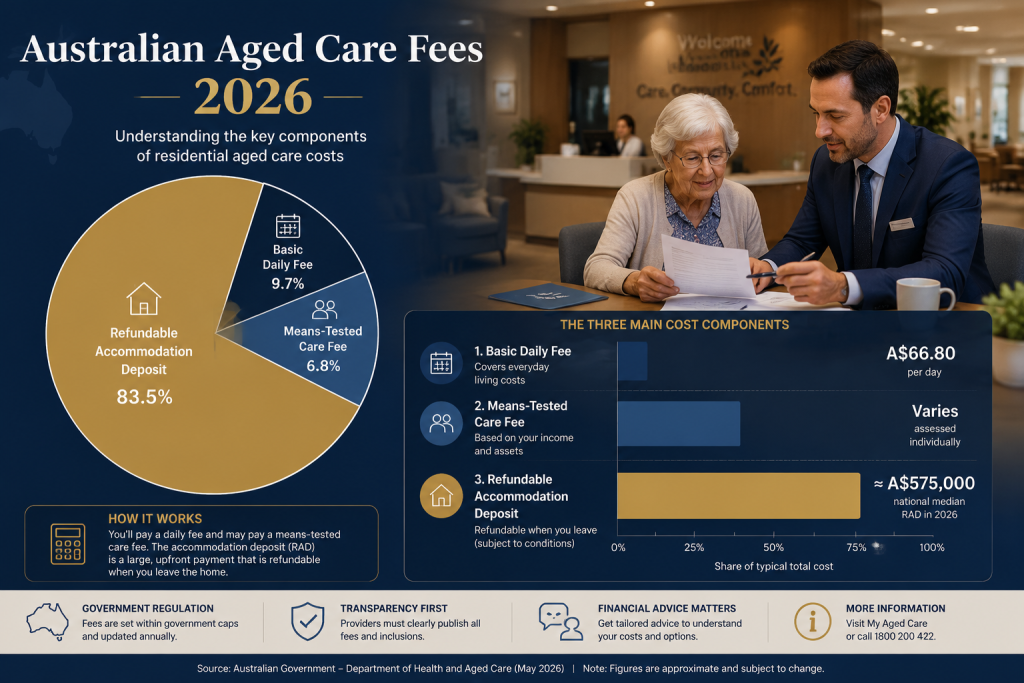
- 💰 Basic Daily Fee for residential aged care is $66.80/day (~$24,382/year) in 2026 [1]
- 🏥 New Hotelling Supplement and Non-Clinical Care Contributions replaced the old means-tested fee from November 2025 [2]
- 🏠 Refundable Accommodation Deposits (RADs) range from $325,000 to $1,437,000 depending on room and location [1]
- 🌏 Melbourne has the highest average RAD ($739,596), followed by Adelaide and Brisbane [1]
- 🏘️ Retirement villages (different from aged care) start around $300,000,$450,000 for basic units [4]
Understanding the True Cost of Retirement Homes in Australia
Before diving into numbers, it helps to know Australia uses two very different systems that people often mix up:
- Residential aged care homes, government-regulated, offer personal and clinical care, and are means-tested.
- Retirement villages, private lifestyle communities for independent seniors, priced like real estate.
The cost of retirement homes differs dramatically between the two. Aged care is regulated by the federal Department of Health; retirement villages are governed by state laws and contracts. If you’re weighing options, our comparison of the pros and cons of retirement village living is a good place to start.
The Basic Daily Fee, Everyone Pays This
Every permanent resident in aged care pays the Basic Daily Fee of $66.80 per day in 2026, that’s roughly $24,382 per year [1]. It’s set at 85% of the single Age Pension and is indexed twice yearly (March and September). This fee covers meals, laundry, cleaning, heating, and general living costs.
Pull Quote: “The Basic Daily Fee alone eats up almost the entire single Age Pension, before accommodation or care costs are added.”
New Means-Tested Contributions (From November 2025)
The old Means-Tested Care Fee was scrapped and replaced with two separate contributions for residents entering care on or after 1 November 2025 [2]:
| Contribution | Who Pays | Daily Cap | Annual Cap | Lifetime Cap |
|---|---|---|---|---|
| Hotelling Supplement (HSC) | Assets above $252,000 | $22.15 | ~$8,085 | None |
| Non-Clinical Care Contribution (NCCC) | Assets above $532,055 | $105.30 | ~$38,435 | $135,319 |
| Basic Daily Fee | Everyone | $66.80 | ~$24,382 | None |
The lifetime cap on the NCCC is a genuine relief, once you hit $135,319, you stop paying that particular contribution [2]. Clinical care (nursing, medication management) remains fully government-funded.
Accommodation Payments: RAD vs DAP
This is where sticker shock often happens. When you enter an aged care home, you’ll be asked to pay for your room in one of three ways:
- Refundable Accommodation Deposit (RAD), a lump-sum, fully refunded when you leave.
- Daily Accommodation Payment (DAP), a daily rent-equivalent, calculated using the Maximum Permissible Interest Rate (MPIR of 8.38% in January 2026) [1].
- A combination of both.
In 2026, published RADs across Australia range from $325,000 for entry-level shared rooms to $1,437,000 for premium suites [1].
Example: A $600,000 RAD paid as a DAP = $600,000 × 8.38% ÷ 365 ≈ $137.75 per day (~$50,278/year).
Average Cost of Retirement Homes by City
Location matters enormously. Melbourne consistently tops the charts, while regional areas can be less than half the price of capital cities.
| City | Average Published RAD (2026) |
|---|---|
| Melbourne | $739,596 |
| Adelaide | $560,882 |
| Brisbane | $487,917 |
| Sydney (premium areas) | $850,000+ |
| Regional NSW/VIC | $300,000,$450,000 |
Source: Best Aged Care Australia [1]
Home Care: The Cheaper Alternative
Not everyone needs to move into a residential facility. Home Care Packages let you receive support in your own home, and the annual cost ranges from $7,500 to $61,000 depending on which of the four levels you qualify for [3].
Home care can be a fraction of the cost of retirement homes while preserving independence, and yes, pets can usually stay. See our guide on how pet-friendly home care actually works.
Retirement Villages: A Different Cost Model Entirely
Retirement villages aren’t aged care, they’re lifestyle communities for independent seniors. The pricing works more like real estate, with three main components:
- Entry price / ingoing contribution: $300,000,$450,000 for basic units; $700,000,$1.5M+ for premium coastal locations [4]
- Ongoing service fees: $400,$1,000+ per month
- Deferred Management Fee (DMF): Typically 25-40% of your entry or sale price, deducted when you leave
The DMF is where many people get caught off-guard. Read our breakdown of common pitfalls of retirement villages before signing anything, and browse our list of top retirement communities across Australia for options.
.cg-calc{font-family:-apple-system,Segoe UI,Roboto,sans-serif;max-width:560px;margin:20px auto;background:#fff;border:1px solid #dbe4ec;border-radius:12px;padding:22px;box-shadow:0 4px 14px rgba(0,0,0,.06)}
.cg-calc h3{margin:0 0 14px;color:#0f4c75;font-size:20px}
.cg-calc label{display:block;font-size:14px;font-weight:600;color:#333;margin:10px 0 4px}
.cg-calc input,.cg-calc select{width:100%;padding:9px;border:1px solid #cfd8e0;border-radius:6px;font-size:14px;box-sizing:border-box}
.cg-calc button{width:100%;margin-top:14px;padding:11px;background:#0f4c75;color:#fff;border:0;border-radius:6px;font-weight:600;cursor:pointer;font-size:15px}
.cg-calc button:hover{background:#0a3a5c}
.cg-result{margin-top:16px;padding:14px;background:#eef6fb;border-radius:8px;font-size:14px;line-height:1.6;display:none}
.cg-result strong{color:#0f4c75}
.cg-note{font-size:11px;color:#666;margin-top:10px;font-style:italic}
💰 Aged Care Annual Cost Estimator (2026)
Under $252,000$252,000, $532,055Above $532,055
Full RAD (lump sum)Full DAP (daily)
function cgCalc(){
var a=parseInt(document.getElementById(‘cg-assets’).value);
var rad=parseFloat(document.getElementById(‘cg-rad’).value)||0;
var pay=document.getElementById(‘cg-pay’).value;
var basic=66.80*365;
var hsc=a>=1?22.15*365:0;
var nccc=a>=2?105.30*365:0;
var accom=pay===’dap’?(rad*0.0838):0;
var total=basic+hsc+nccc+accom;
var msg=’Estimated Annual Out-of-Pocket: $’+total.toLocaleString(‘en-AU’,{maximumFractionDigits:0})+’
‘;
msg+=’• Basic Daily Fee: $’+basic.toLocaleString(‘en-AU’,{maximumFractionDigits:0})+’
‘;
if(hsc)msg+=’• Hotelling Supplement: $’+hsc.toLocaleString(‘en-AU’,{maximumFractionDigits:0})+’
‘;
if(nccc)msg+=’• Non-Clinical Care: $’+nccc.toLocaleString(‘en-AU’,{maximumFractionDigits:0})+’
‘;
if(accom)msg+=’• Accommodation (DAP): $’+accom.toLocaleString(‘en-AU’,{maximumFractionDigits:0})+’
‘;
if(pay===’rad’)msg+=’• RAD paid as $’+rad.toLocaleString(‘en-AU’)+’ lump sum (refundable)’;
document.getElementById(‘cg-out’).innerHTML=msg;
document.getElementById(‘cg-out’).style.display=’block’;
}
How to Pay for Retirement Home Costs
For most Australians, the cost of retirement homes is met through a mix of:
- Age Pension, currently ~$29,754/year for singles, ~$44,855 for couples
- Superannuation drawdowns or account-based pensions
- Sale or rental of the family home
- Refundable Accommodation Deposit funded by home sale
Planning ahead is everything. Our guide to planning your retirement income walks through the mechanics, and if you’re still working, look into transition to retirement income streams to bridge the gap.
The Family Home Question
Under current rules, if your former home is occupied by a protected person (spouse, dependent child, or long-term carer), it’s exempt from the aged care means test. Otherwise, only the first ~$206,000 of its value is counted. This is why many families choose to keep the house, rent it out, and use the income to pay a DAP.
Government Safety Nets
If your assets and income fall below thresholds, you may qualify as a low-means resident, and the government subsidises your accommodation entirely. Roughly 35% of new residents enter care as low-means [2].
Hidden and Extra Costs to Watch For
Beyond the headline fees, budget for:
- Extra Services fees ($15,$75/day) for wine with meals, premium bedding, hairdressing, foxtel
- Personal expenses, pharmacy, clothing, phone, entertainment
- Additional Services packages, increasingly common in premium homes
- Exit fees at retirement villages, the DMF plus refurbishment costs
Staying active and well can also reduce long-term care needs. Simple daily habits, like eating high-fibre foods for seniors and staying socially engaged with meaningful activities in retirement, can delay the need for higher-level care packages significantly.
Conclusion: Making Sense of the Numbers
The 2026 cost of retirement homes in Australia is higher and more complex than ever, but the system is more transparent than most people assume. Between the flat Basic Daily Fee, the new asset-tiered contributions, and the RAD/DAP choice, you have genuine flexibility, as long as you plan early.
Your next steps:
- Get a free aged care assessment (ACAT), required for any government-subsidised care.
- Use My Aged Care’s fee estimator for a personalised quote based on your assets and income.
- Talk to an aged care financial specialist, many offer flat-fee consultations under $2,000.
- Compare at least 3-5 homes in your preferred area. Published RADs are negotiable.
- Read every contract twice, especially any retirement village agreement with a DMF clause.
The best time to research the cost of retirement homes is at least 5-10 years before you’ll need one. Waiting until a crisis forces the decision almost always costs more, both financially and emotionally.
References
[1] Aged Care Cost Australia 2026 – https://bestagedcareaustralia.com.au/guides/aged-care-cost-australia-2026/
[2] Residential Aged Care Costs – https://www.nestwise.net.au/guides/residential-aged-care-costs
[3] Aged Care Cost Guide – https://bestagedcareaustralia.com.au/guides/aged-care-cost-guide/
[4] New Retirement Villages In Australia For 2025 – https://mytips.com/en/articles/new-retirement-villages-in-australia-for-2025
[5] How Much To Retire Australia – https://www.otivo.com/resources/learn/how-much-to-retire-australia
[6] Age Pension – https://sortedaus.com.au/payments/age-pension/