
Nearly 2.65 million Australians provide unpaid care to family members, yet thousands miss out on government support simply because they don’t know what’s available. If you’re helping your ageing mum or dad navigate the system, understanding centrelink elderly parents assistance could mean the difference between your parents thriving in their later years and merely getting by. The good news? There’s more support than most families realise, you just need to know where to look and how to apply.
Key Takeaways
- The Age Pension provides up to $1,200.90 per fortnight for eligible singles aged 67 and over [1]
- Carer Payment and Carer Allowance offer financial support if you provide ongoing daily care to your parents [2][3]
- Home Care Packages fund in-home services across four levels, helping your parents stay in their own home longer [5]
- Pensioner Concession Cards and Commonwealth Seniors Health Cards significantly reduce healthcare and living costs [4]
- Applying early and gathering the right documents makes the whole process smoother and faster
Understanding the Centrelink Elderly Parents Assistance Landscape
When my own mum turned 67 last year, I had no idea where to start. The Centrelink system can feel like a maze of acronyms, forms, and eligibility tests. But once you break it down, the core programs are actually pretty straightforward.
The foundation of centrelink elderly parents assistance is the Age Pension. Australians aged 67 and over may qualify, subject to residency, income, and asset tests [1]. It’s not automatic, your parents need to apply, and Centrelink will assess their financial situation to determine both eligibility and payment rate.
Beyond the Age Pension, there’s a whole ecosystem of support. Your parents might also access:
- Pensioner Concession Card, automatically issued to Age Pension recipients, offering discounts on healthcare, utilities, and public transport [4]
- Commonwealth Seniors Health Card, for those who don’t qualify for the Age Pension but still need cheaper healthcare (income test only, no asset test) [4]
- Home Equity Access Scheme, a voluntary, non-taxable fortnightly loan using real estate as security to boost retirement income [4]
- Home Care Packages, government-funded in-home care services [5]
The key is understanding which of these your parents are eligible for and how they can work together.
How the Income and Asset Tests Work
Centrelink uses two tests to determine Age Pension eligibility, and they apply whichever test gives the lower payment rate:
- Income Test, Centrelink looks at all income sources: employment earnings, superannuation pensions, investment returns, rental income, and some deemed income from financial assets
- Asset Test, This counts the value of assets your parents own, including property (other than the family home), vehicles, superannuation balances (if over pension age), shares, and savings
Your parents’ principal home is exempt from the asset test, which is important to remember. Many families assume their home disqualifies them, but it doesn’t.
Key Payments Available Through Centrelink Elderly Parents Assistance
Let’s break down the main payments so you know exactly what your parents might receive.
Age Pension: The Foundation
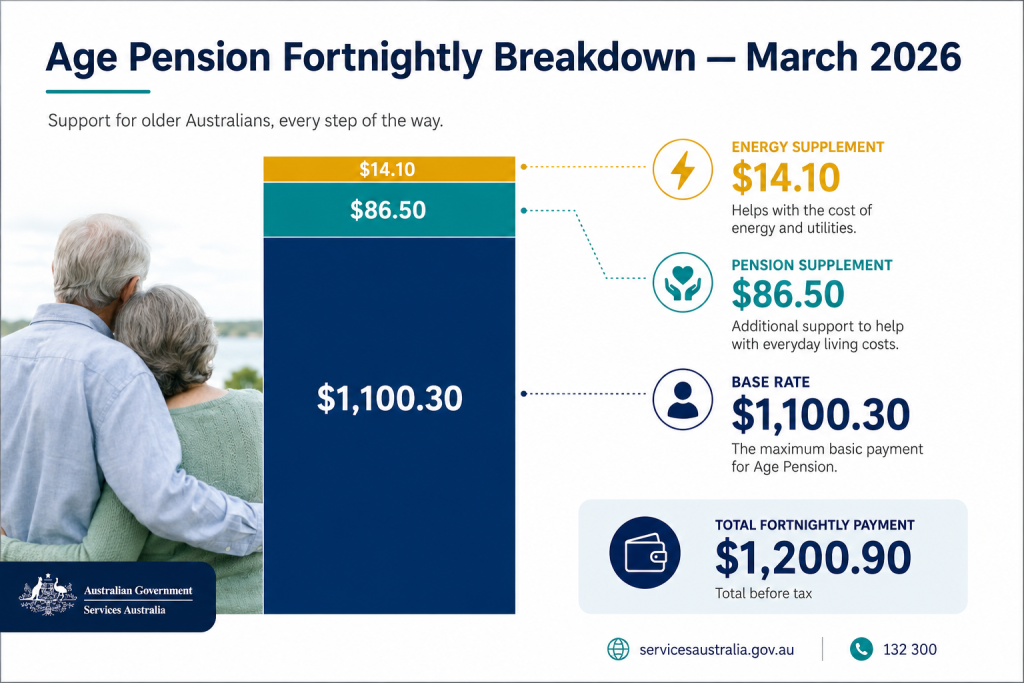
As of March 2026, the maximum fortnightly Age Pension payment for a single person is $1,200.90. This breaks down into [1]:
| Component | Amount (Fortnightly) |
|---|---|
| Base rate | $1,100.30 |
| Pension supplement | $86.50 |
| Energy supplement | $14.10 |
| Total (single) | $1,200.90 |
For couples, the combined maximum is slightly lower per person. The actual amount your parents receive depends on the income and asset tests.
Pensioner Concession Card
If your parent qualifies for the Age Pension, they’ll automatically receive a Pensioner Concession Card [4]. This card is a quiet powerhouse. It can reduce:
- Prescription costs under the PBS
- Council rates
- Electricity and gas bills
- Public transport fares
- Some property and water rates
These savings can add up to thousands of dollars each year.
Commonwealth Seniors Health Card
What if your parents don’t qualify for the Age Pension because they have too many assets? They might still be eligible for the Commonwealth Senitors Health Card [4]. This card is income-tested but not asset-tested, making it accessible to self-funded retirees who fall above the Age Pension threshold but still want cheaper healthcare and medicines.
Home Equity Access Scheme
Formerly called the Pension Loans Scheme, this program lets eligible seniors receive a voluntary, non-taxable fortnightly loan from the government, using their real estate as security [4]. It’s an option for asset-rich, cash-poor retirees who own property but need more regular income.
If your parents own their home but are struggling with day-to-day expenses, this scheme could be worth exploring. Just keep in mind that the loan accrues over time and is eventually repaid from the estate or when the property is sold.
💡 Quick tip: Use the interactive tool below to get a quick sense of which payments your parents might be eligible for.
Home Care Packages: Keeping Your Parents at Home Longer
Most older Australians want to stay in their own homes for as long as possible. That’s where Home Care Packages come in, one of the most valuable forms of centrelink elderly parents assistance available [5].
There are four levels of Home Care Packages, each tailored to different care needs:
| Level | Care Type | Best For |
|---|---|---|
| Level 1 | Basic care | Minimal support needs |
| Level 2 | Low-level care | Some daily assistance |
| Level 3 | Intermediate care | Moderate care needs |
| Level 4 | High-level care | Complex, ongoing care |
These packages can fund services like:
- Personal care (showering, dressing, grooming)
- Domestic assistance (cleaning, laundry)
- Nursing care and medication management
- Meal preparation and nutrition support
- Transport to medical appointments
- Garden maintenance and home safety modifications
How to Apply for a Home Care Package
The process involves a few key steps:
- Contact My Aged Care, This is the national gateway for aged care services. You can call them or apply online.
- Arrange an assessment, An assessor visits your parent’s home to determine the level of care needed.
- Wait for approval, Unfortunately, there can be wait times, especially for Level 3 and 4 packages.
- Choose a provider, Once approved, you select an approved provider to deliver the services.
💡 Tip: Apply early. Wait times for higher-level packages can stretch months, so it’s better to get in the queue before your parent urgently needs the care.
If your parent has a pet they can’t bear to part with, you’ll be glad to know that pet-friendly home care exists, so companion animals don’t have to be a barrier to receiving support.
Carer Payments: Support for You While You Support Them
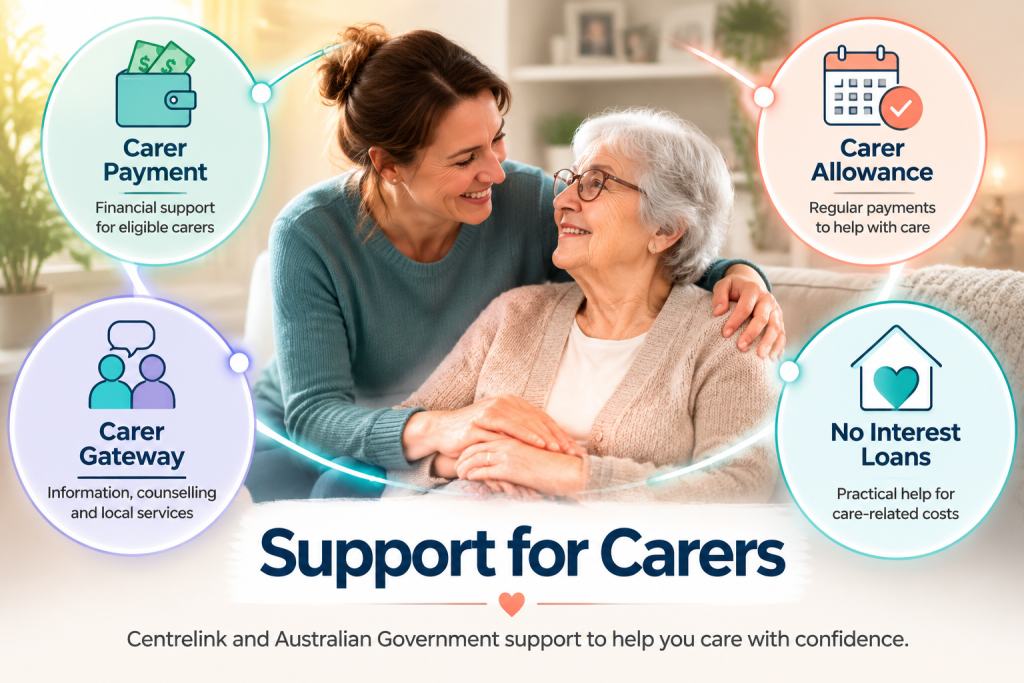
Here’s something many people don’t realise: if you’re providing ongoing care to your elderly parent, you might be eligible for financial support too. The Australian government offers several payments specifically for carers [6].
Carer Payment
The Carer Payment is an income support payment for people who provide constant care to someone with a disability, medical condition, or who is frail aged [2]. If your caregiving responsibilities prevent you from working full-time, this payment could be a lifeline.
Key eligibility requirements:
- You must provide care for at least six months (or the care recipient is terminally ill)
- You must meet income and assets tests
- The care recipient must need a significant level of care
As of April 2026, the Carer Payment and Carer Allowance have been updated to reflect current economic conditions [3], so it’s worth checking the latest figures when you apply.
Carer Allowance
Unlike the Carer Payment, the Carer Allowance is not means-tested [3]. This means it’s available to a broader range of carers, regardless of your income or assets. It’s a supplementary payment designed to help offset the daily costs of providing care.
You can receive both the Carer Payment and Carer Allowance simultaneously if you meet the eligibility criteria for both.
Carer Gateway and Additional Support
Beyond direct payments, the government provides support through Carer Gateway, a national service offering [6]:
- Practical support and advice
- Counselling sessions
- Respite care options
- Skills training for carers
- Emergency respite if you suddenly can’t provide care
Being a carer can be isolating and exhausting. If you’re struggling to stay connected with others, there are simple ways to connect with seniors in social isolation that can help both you and your parent feel less alone.
No Interest Loans for Essential Goods
If money is tight, eligible individuals can access No Interest Loans (NILs) through Good Shepherd [7]. These loans help with essential goods and services like:
- Household appliances (fridges, washing machines)
- Car repairs
- Medical equipment
- Furniture and mattresses
There’s no interest charged, making them a much safer alternative to payday loans or high-interest credit cards.
Practical Steps to Apply for Centrelink Elderly Parents Assistance
Ready to get started? Here’s a practical, step-by-step approach:
Step 1: Gather Your Parent’s Documents
Before you do anything else, collect:
- Birth certificate or passport (proof of age and identity)
- Proof of residency (if your parent wasn’t born in Australia)
- Recent bank statements
- Tax return notices
- Details of any income (superannuation, investments, rental income)
- Property valuations and asset details
- Medical reports (if applying for carer payments or Home Care Packages)
Step 2: Create a myGov Account
If your parent doesn’t already have one, help them set up a myGov account and link it to Centrelink. This is the easiest way to manage claims, report income, and track payments online. You can also set up a Centrelink nominee arrangement so you can act on your parent’s behalf if they prefer.
Step 3: Lodge the Right Claims
Different payments require different claim forms. The main ones to look at:
- Age Pension, Claim through Centrelink online or by phone
- Carer Payment/Allowance, Claim if you’re the one providing care [2][3]
- Home Care Package, Apply through My Aged Care [5]
- Commonwealth Seniors Health Card, If your parent doesn’t qualify for the Age Pension [4]
Step 4: Follow Up
Centrelink processes can take time. Don’t be afraid to follow up. Keep a record of:
- Reference numbers from phone calls
- Names of staff you speak with
- Dates of submissions
- Any requests for additional information
Step 5: Get Professional Help if Needed
If your parents’ financial situation is complex, multiple properties, self-managed super, trusts, consider speaking to a financial adviser who understands the Centrelink system. They can help structure assets to maximise entitlements legally.
For broader retirement planning, our retirement income planning guide walks through how to create a sustainable income strategy, and our guide on transition to retirement income streams explains how your parents can access super while still working. You might also find our retirement savings account guide helpful for understanding how savings accounts interact with government support.
Common Mistakes to Avoid
I’ve seen families make the same mistakes over and over. Here’s how to steer clear:
❌ Assuming your parents won’t qualify. Many families don’t even try because they assume they earn too much or have too many assets. But the income and asset tests have thresholds, and you might be surprised. The Commonwealth Seniors Health Card, for example, has no asset test at all [4].
❌ Waiting too long to apply. Home Care Packages have wait times. Age Pension claims take weeks to process. The earlier you start, the sooner support kicks in.
❌ Forgetting about carer payments. If you’re providing daily care to your parent, you might be eligible for Carer Payment and Carer Allowance, yet many carers don’t realise this support exists [6].
❌ Not reporting changes. If your parent’s income, assets, or living situation changes, you must tell Centrelink. Failing to do so can result in overpayments that need to be repaid, and potential penalties.
❌ Overlooking concession cards. The Pensioner Concession Card and Commonwealth Seniors Health Card can save your parents thousands per year on healthcare and utilities [4]. Don’t let these slip through the cracks.
❌ Ignoring nutrition and wellbeing. Financial support is just one piece of the puzzle. Make sure your parents are eating well, a geriatric nutritionist can help address age-specific dietary needs, and high-fiber foods can prevent constipation issues common in older adults. If you’re considering retirement village living, our breakdown of the cost of retirement homes can help you compare options.
Conclusion
Navigating centrelink elderly parents assistance doesn’t have to be overwhelming. The system offers real, meaningful support, from the Age Pension and concession cards to Home Care Packages and carer payments, but it only works if you know what’s available and take action.
Here’s what to do next:
- Check your parent’s Age Pension eligibility, If they’re approaching 67, start the conversation now
- Apply for a Home Care Package through My Aged Care, Even if your parent doesn’t need much help yet, getting in the queue early is smart
- Explore Carer Payment and Carer Allowance if you’re providing daily care, you deserve support too
- Gather documents and set up a myGov account, Being organised makes every step faster
- Consider speaking to a financial adviser if your parents’ situation is complex
You don’t have to figure this out alone. The support is there, you just need to ask for it.
References
[1] Centrelink Payments And Benefits Types And Eligibility – https://legalclarity.org/centrelink-payments-and-benefits-types-and-eligibility/?utm_source=openai
[2] Carer Payment – https://my.gov.au/en/services/health-and-disability/caring-for-someone/becoming-a-carer/government-support-for-carers/carer-payment?utm_source=openai
[3] Carer Allowance – https://my.gov.au/en/services/health-and-disability/caring-for-someone/becoming-a-carer/government-support-for-carers/carer-allowance?utm_source=openai
[4] Centrelink Entitlements – https://www.mercer.com/en-au/solutions/mercer-financial-advice/centrelink-entitlements/?utm_source=openai
[5] Everything You Need To Know About Centrelink Home Care Package – https://www.myguardian.com.au/home-care/everything-you-need-to-know-about-centrelink-home-care-package/?utm_source=openai
[6] Government Support For Carers – https://my.gov.au/en/services/health-and-disability/caring-for-someone/becoming-a-carer/government-support-for-carers?utm_source=openai
[7] Government Help With Money – https://my.gov.au/en/services/work/managing-the-cost-of-living/government-help-with-money?utm_source=openai
Meta Title: Centrelink Elderly Parents Assistance: A Complete 2026 Guide
Meta Description: Learn how to access Centrelink elderly parents assistance in 2026, Age Pension, carer payments, Home Care Packages, concession cards, and step-by-step application tips.
Tags: centrelink elderly parents assistance, Age Pension, carer payment, carer allowance, Home Care Packages, Pensioner Concession Card, Commonwealth Seniors Health Card, aged care, retirement planning, carer support, Home Equity Access Scheme